

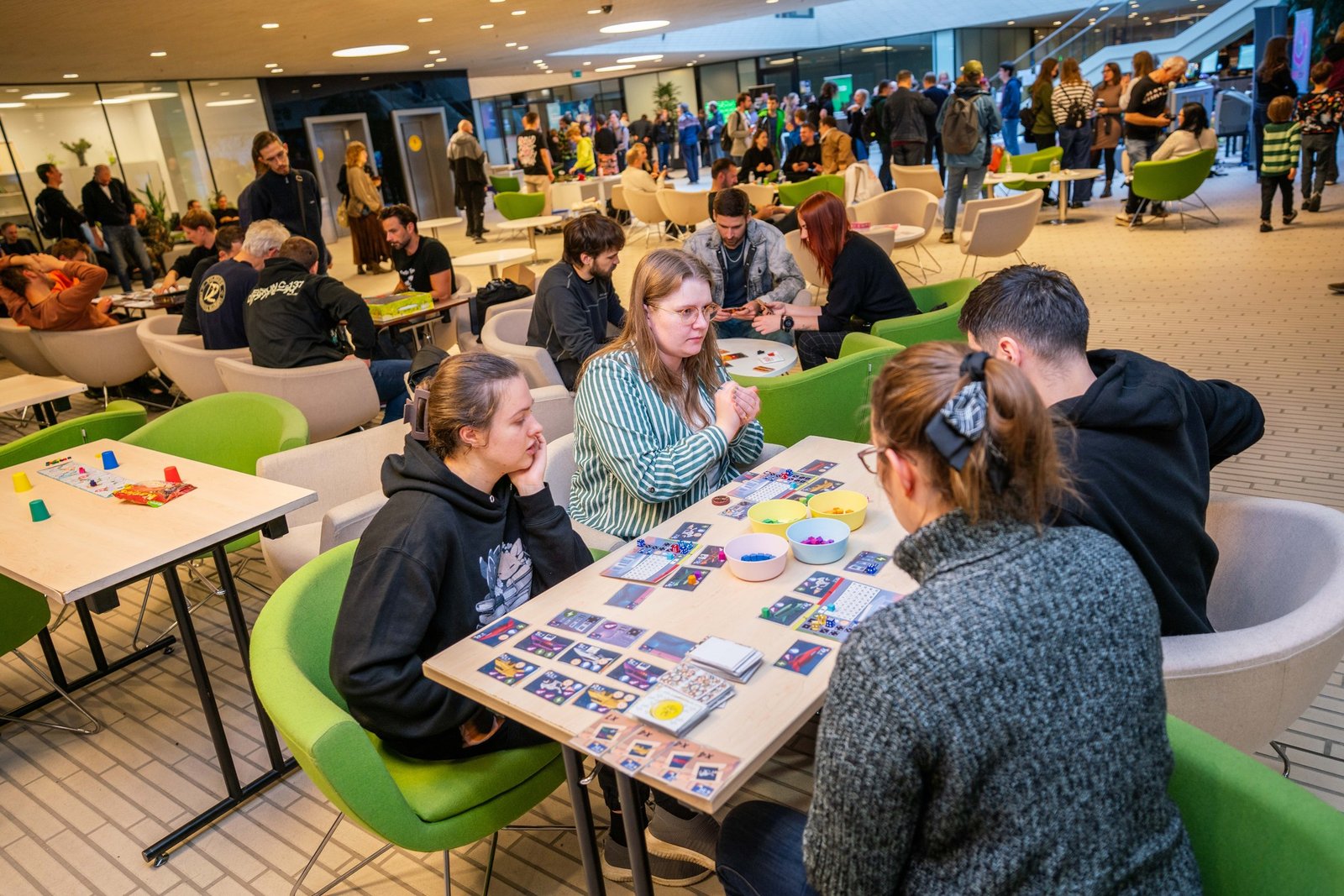
This year was particularly interesting for me because I joined the Vilnius Prototype Club. There, we regularly test new, in-development, or nearly finished games that have not yet reached the market. We also take part in various events, mostly related to education and game facilitation.
From the very beginning, I jumped into this world headfirst. I met many designers whom I will probably write about sooner or later, but this time I want to focus on unpublished board game prototypes. Some of them I played at the PineCon festival, others during our regular Wednesday meetups. As the year comes to an end, I want to briefly highlight four prototypes that stood out to me the most — games I would buy without hesitation if I saw them on a store shelf.
Venturesome Detective by Valerij Selivanov
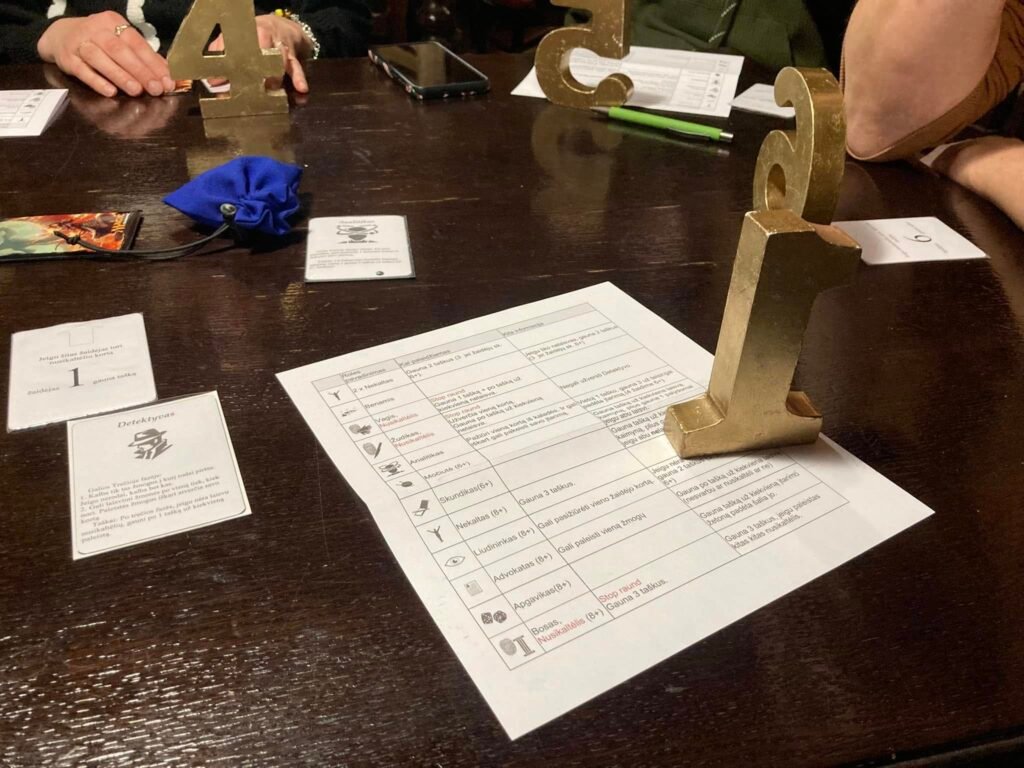
This is a social deduction / hidden role game, similar in spirit to Mafia, Avalon, or Citadels. Each round, players take on roles and try to identify one another based on the information available to them. Importantly, the game does not rely on random guessing — every player has a defined amount of information: some knowledge about their neighbors and a general understanding of the types and number of roles in play.
This amount of information is more than enough for manipulation, humor, unexpected alliances, and various forms of leadership to emerge, depending on the players’ personalities.
The game also includes a betting mechanic using poker chips. This allows players to manage their level of risk: if you are unsure, you can play cautiously; if you pursue more ambitious or Machiavellian goals, you can take bigger risks. This creates a dynamic environment where not only logic matters, but also personality. The game is especially enjoyable in social settings, as it quickly reveals how people think, trust, lead, hesitate, or follow.
It is a very strong design. I sincerely hope Valerijus publishes it. Anyone interested can follow the Game Inn Facebook page, where the game is occasionally hosted live, or simply reach out to Valerijus directly — I’m sure he’ll be happy to share it.
Baltic Rites by Žilvinas Andriuškevičius

Genre-wise, this game is not easy to define. It is not a classic deck-building game, as there is no traditional deck construction process. A more accurate description would be a deck-based brawler.
At the start of the game, each player chooses a Baltic deity (such as Žemyna or Bangutis), and most of their deck consists of cards tied to that deity’s element. The remaining cards are shared, neutral cards available to both players.
The goal is to reduce the opponent’s life resource to zero. As in many games of this type, there is a strong sense of progression: the game starts slowly and simply, but over time, both spells and creatures grow stronger, eventually reaching a breaking point. In some cases, this climax is marked by summoning a Baltic deity onto the battlefield.
The game left a very positive impression on me — helped, admittedly, by the fact that I managed to win. Visually, it already looks strong, even though it currently exists only in illustrated form. I played it twice, and both times clearly felt a satisfying “snowball” effect: actions matter, decision space is not overwhelming, and progress feels earned, leading toward a clear power peak.
The game still needs balancing, but its direction and potential are already very clear. In my view, the biggest challenge will be managing that balance — or perhaps deliberately allowing some imbalance, which might actually become part of its appeal.
Ecosystems by Andrejus Avchimovičius
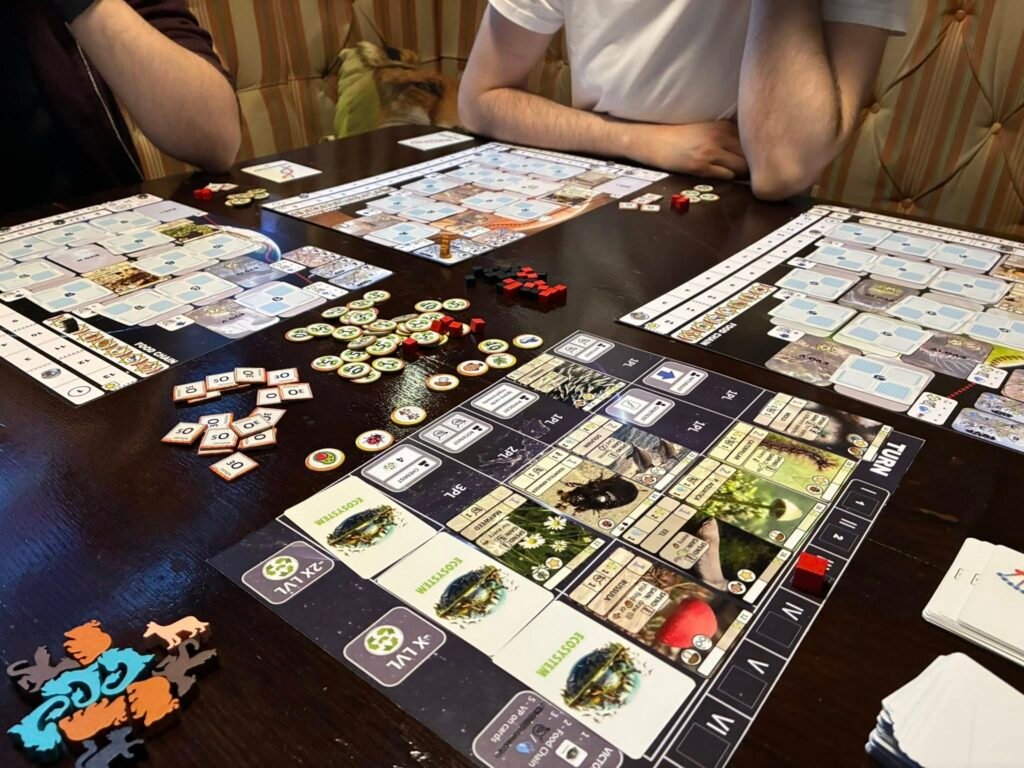
Ecosystems is a tableau builder / engine-building game in which players develop their own planetary ecosystem. The core idea is to combine species, resources, and effects in a way that creates an efficient and synergistic system that generates victory points and other benefits over time.
Each player starts with a slightly different planet, but everyone operates within a shared economic space. Key resources include water, oxygen, temperature, and bioenergy, which define the range of possible actions. During the game, players expand their tableau, acquire cards, activate effects, and build increasingly complex combinations of species.
One of the game’s strengths is that there is no single optimal path to victory. Players can focus on different resources, engine efficiency, or even indirectly disrupt opponents by acquiring cards they need. Decisions made early on have long-term consequences, but the system still allows room to adapt and recover.
Ecosystems has a long development history. According to its creator, the first versions appeared as early as 2021, after which the game was thoroughly reworked and rebalanced. Its current form is the result of many iterations and playtests, which is why it feels fair to say that it is only a “prototype” in name — in practice, it is a mature, coherent, and complete board game, comparable to many published titles.
4 Islands by Tadas Kastanauskas, Valerijus Selivanov, and Mantas Minkauskas
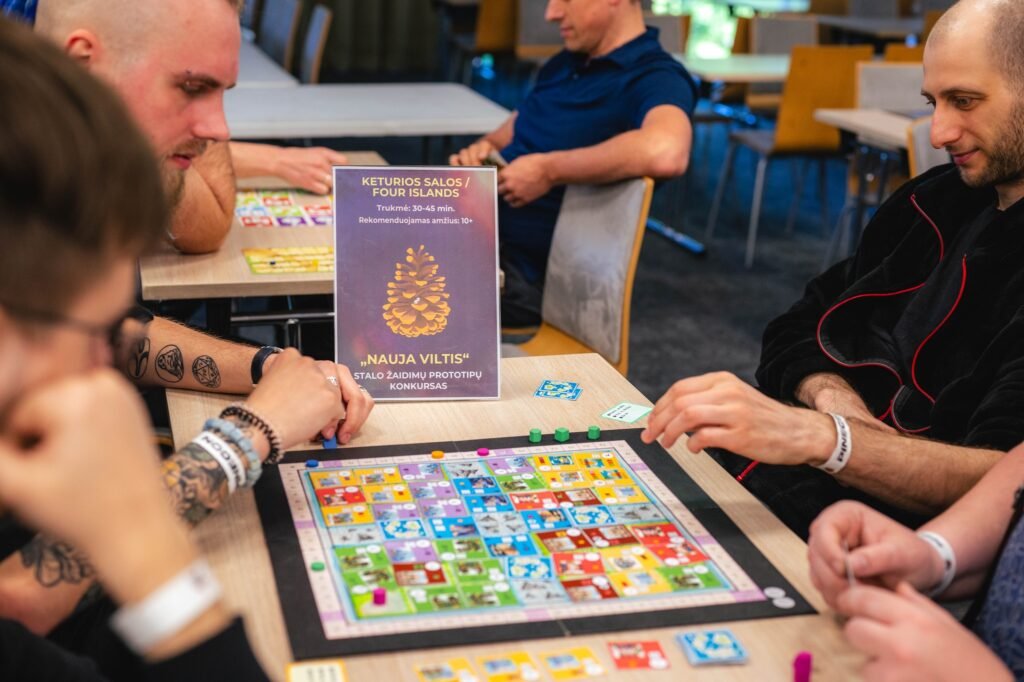
This game can be described as a mix of area control and city-building elements, although neither label fully captures it. For some reason, it reminds me of The Settlers of Catan — but in a more refined and, to my taste, more successful form.
There is no dice in the game, which significantly reduces randomness. Players do not need to constantly “balance” each other by blocking actions, although sabotage is still possible. The game takes place across four islands, where players assign workers to claim territory and construct buildings such as hotels or shops.
The game allows for very different strategies. Players can focus on a single area, expand across multiple islands (or even across the water between them), specialize in certain building types that score better when grouped together, or deny opponents access to key structures.
One of the biggest strengths of the game is its accessibility. The rules can be explained in just a few minutes, yet the decision space remains surprisingly deep. In a time when information overload often discourages people from starting new things, this clarity and conciseness feel especially valuable.
For me, this is a strong family euro-style game that offers a lot of enjoyment without unnecessary complexity. A very solid design.
Closing
To conclude, this year has been a very productive one for Lithuanian board game creators. Many games have already been released, and many more are still in development. Hopefully, at least some of these prototypes will find publishers in the near future and reach a wider audience. They already have at least one buyer.
Happy New Year,
Petras Šimonis

Leave a Reply