
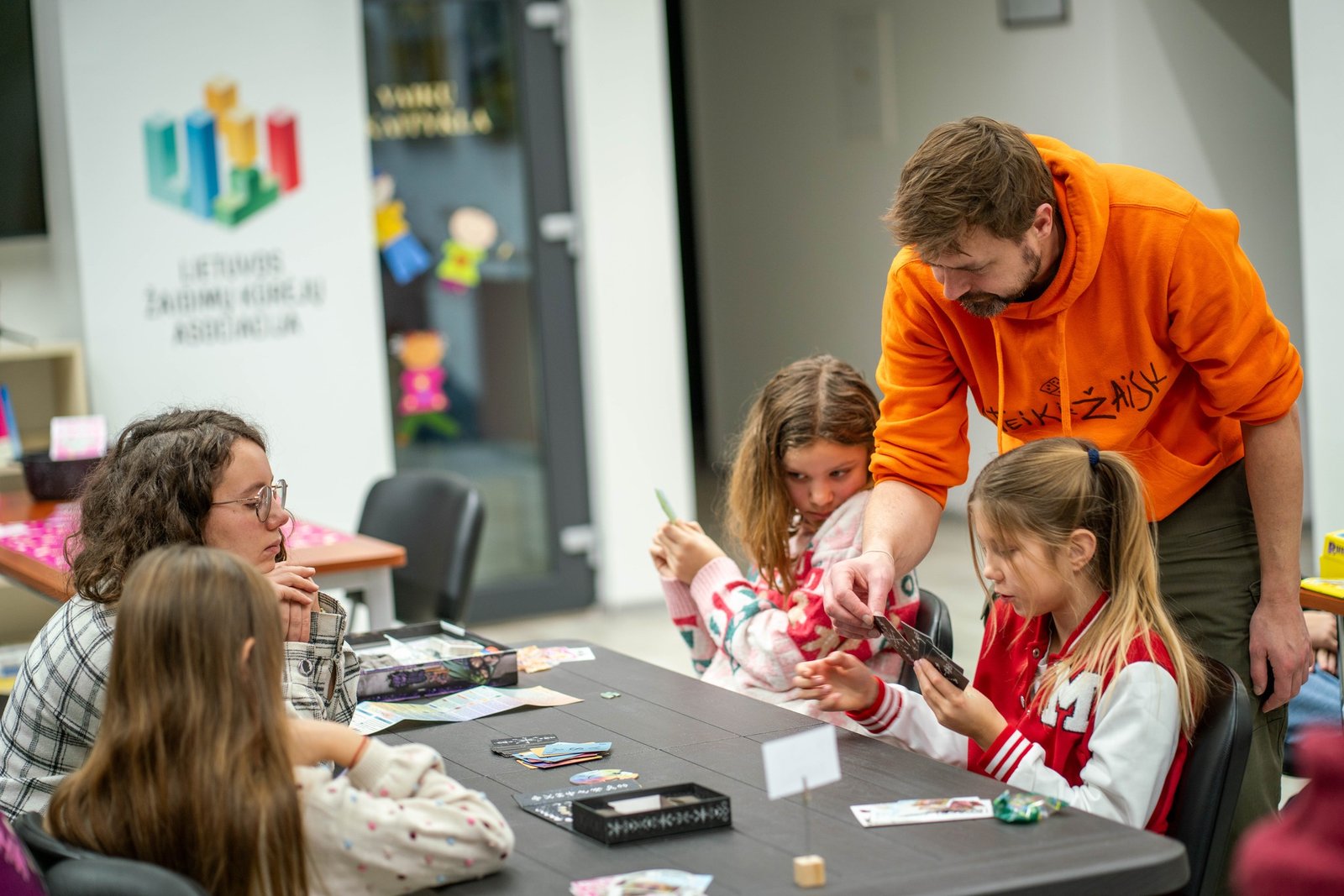
You have attended many festivals, competitions, hosted game nights, and educational events. If you had to compare smaller festivals and distill the experience, why is it worth traveling to a festival of Essen Spiel’s scale?
It is worth going simply to understand the sheer scale. This year, around 220,000 people attended the festival over four days. The flow of people is almost impossible to comprehend, along with the constant noise and buzz. Every few hours you feel the need to step outside just to give your ears a break.

When you return home, you clearly realize how early in development we still are. In Western countries, board games have been played for generations, with families, relatives and friends gathering around the same table. Essen makes it very clear that behind this hobby stand serious businesses. Despite all the challenges of recent years, this archaic form of entertainment has not only survived but continues to grow, approaching a global market size of around 30 billion.
Official SPIEL Essen sources state that more than 1,700 new games, including reprints, were presented this year. What do these numbers say to you as an active game designer?
These numbers are becoming increasingly difficult to grasp. You try to imagine such a stream of new releases and calculate how many games you would need to play each day to experience them all before the next Essen. And behind that, there are still hundreds of older, unplayed games, even some that have won the Spiel des Jahres award.

The flow is massive. One might expect quality to drop as quantity increases, but that is not the case. On the other hand, it is becoming harder to identify something truly original. Everything seems to revolve in a spiral around the same mechanics and genres, simply dressed in a more modern form.

Sometimes it feels like too many games are being created, as most of them are destined to disappear into the currents of history without ever reaching a second print run.
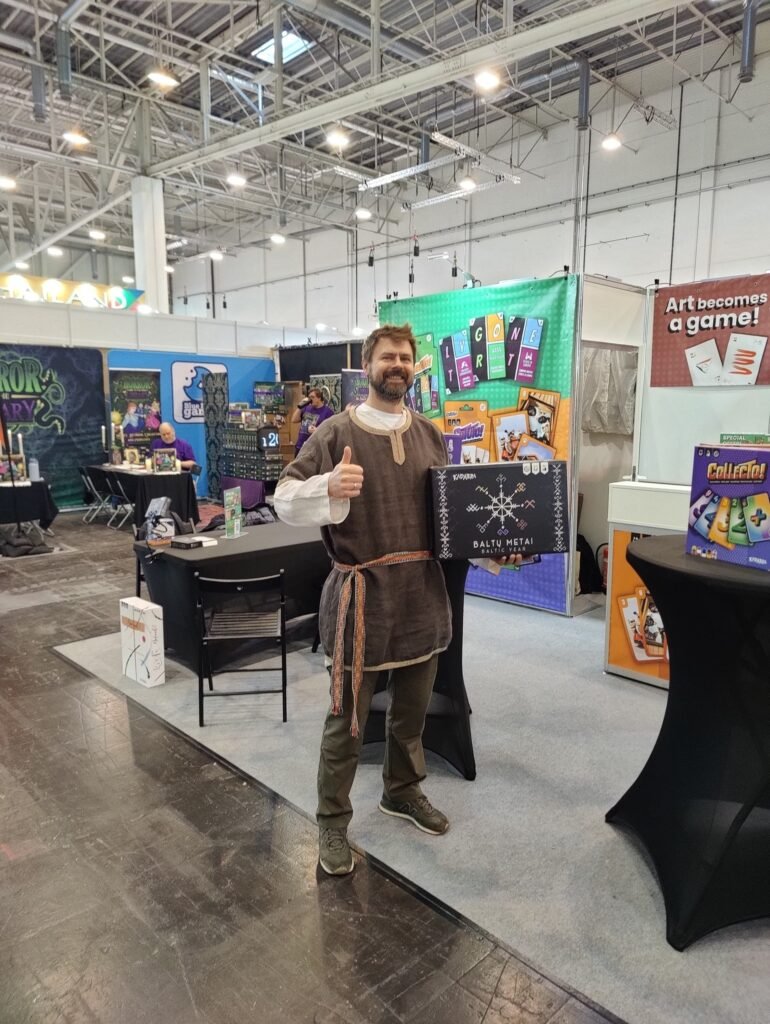
Your game Baltų metai was mentioned several times on The Dice Tower, the largest board game YouTube channel. That is a rare achievement for a designer from Lithuania. Can you briefly describe the game and how it was received at the festival?
That mention happened in a completely comic and unexpected way. The Dice Tower was preparing a preview of upcoming Essen releases and made a small filtering mistake. As a result, Baltų metai ended up in second place on their list.

The team took the time to review the visuals on BoardGameGeek, read the description and described the game as abstract in nature. Visually, it reminded them of Scandinavian runes. Since the entire Dice Tower team was present in Essen with their own booth, we wrote them a note inside the Baltų metai box, thanked them for the free promotion and explained that Balts are not Scandinavians and our Baltic symbols are not runes.

They took it with humor and later, in another video about games they purchased at Essen, they mentioned Baltų metai again.

Throughout all four days, I stayed at the Kadabra Hobbyshop booth, dressed in ancient Baltic traditional clothing, teaching the rules to interested visitors. Some were attracted by the visuals, similar to what happens with your ModernO. Others came because they had marked the game in the Essen Spiel app as suitable for larger groups.

Visitors from neighboring countries, Latvians, Ukrainians, and Poles, immediately recognized familiar symbols. Most interestingly, the game seemed to radiate a certain mysticism and symbolism. People from all over the world, even from distant places like New Zealand or South Africa, stopped by and recognized elements of their own ethnic folklore in our Baltic symbols.
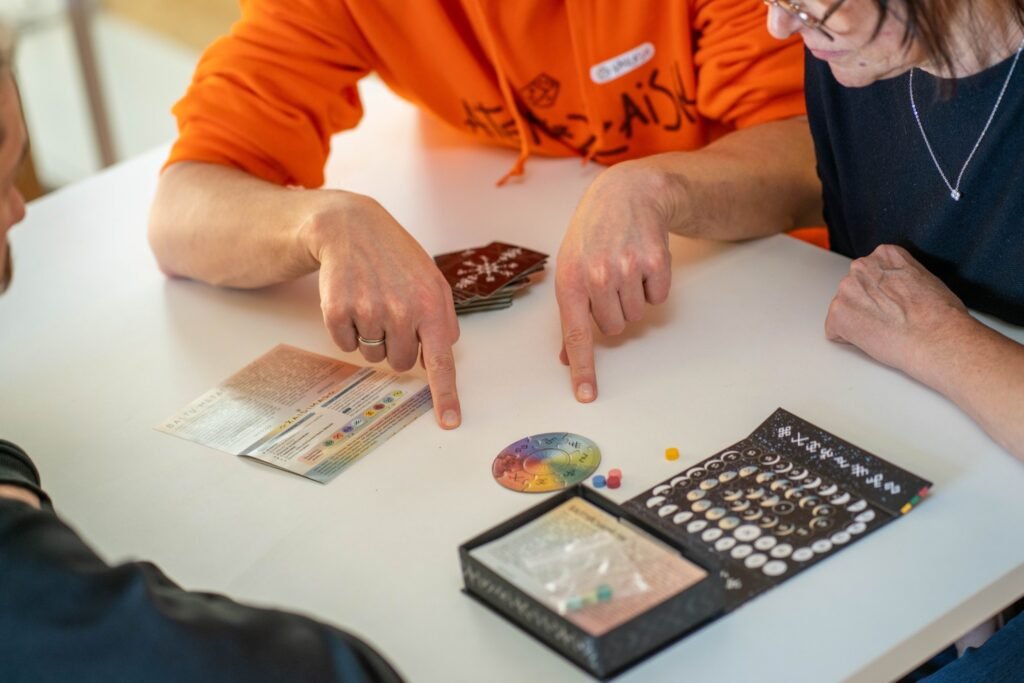
Designing a board game and presenting it are two different disciplines. When creating a game, do you think about how you will teach it? And when presenting games, do you modify them based on the audience?
When designing a game, I never think about how I will teach it. However, I focus heavily on refining actions and rules to eliminate ambiguity. At the moment, I deliberately focus on lighter, simpler games, as I do not see strong opportunities to release heavier titles for the local market.

My focus is on filler and light euro games. When explaining rules, adaptation to the audience is always necessary. For players who only know Uno, even simple games can seem complex. In such cases, rules need to be broken into steps, or some elements temporarily removed and introduced later after a few rounds.

For experienced gamers, just a few minutes are often enough to fully grasp the rules.
You have mentioned noticing certain trends, particularly that people want short, clear, and accessible games. After this year’s experiences, what can you say about that? What do people actually want?
That is a good question. I think many people do not fully know themselves. Still, at least two extreme groups can be identified.

The first group looks for very quick rules explanations, fast setup, and games that do not get boring too quickly. A good example would be Flip 7, which made it into the Spiel des Jahres shortlist last year.

The second group consists of hardcore gamers who seek increasingly complex, deeper rules and decisions. SETI: Search for Extraterrestrial Intelligence would be a good example here.

Everyone else falls somewhere in between. These are people discovering classics for the first time, light Euro enthusiasts, or party game fans. They enjoy games as a form of leisure, especially when there is at least one enthusiast in the group who knows the rules well.
Leave a Reply